
The best waterfalls in Tennessee run the full spectrum. You’ve got a 145-foot underground waterfall inside a cave on Lookout Mountain, roadside cascades in Cherokee National Forest, natural swimming holes across the Cumberland Plateau, and serious gorge hikes inside Great Smoky Mountains National Park. That range is hard to match anywhere else in the South, and it means no matter your experience level or how much time you have, there is something on this list worth making the drive for.
I’ve been chasing waterfalls in Tennessee since we settled into the Chattanooga area, and as a photographer I find them one of the more rewarding subjects out there. Getting the light right, dialing in the shutter speed for that silky blur, working the angle on a shot. A good waterfall gives you a lot to work with. I’ve personally visited a few of the 13 falls on this list and have plans lined up for the rest. For those I haven’t made it to yet, I’ve done the research so you have what you need to plan your own visit.
And if you want to string them all together, I’ve put together a five-day Tennessee waterfall road trip route at the end of this post that loops from Chattanooga through the plateau, the Smokies, and back. Here’s the full list.
This post contains affiliate links. Clicking on them costs you nothing, but it does help support my blog. I promise to never recommend a product or service that I haven’t tried or done plenty of research on. Thanks for reading and supporting!
Quick Reference: 13 Best Waterfalls in Tennessee
| Waterfall | Location | Difficulty | Approx. Trail Length |
|---|---|---|---|
| Ruby Falls | Lookout Mountain, Chattanooga | N/A (guided tour) | N/A |
| Foster Falls | Marion County | Easy | Less than 1 mi RT |
| Greeter Falls | Savage Gulf SP, Grundy County | Moderate | ~2 mi RT |
| Fall Creek Falls | Fall Creek Falls SP, Van Buren County | Easy (overlook) / Strenuous (base) | Short to overlook |
| Rock Island / Great Falls | Rock Island SP, White County | Easy to Moderate | Short to overlook |
| Burgess Falls | Burgess Falls SNA, Putnam County | Moderate | 1.3 mi RT |
| Cummins Falls | Cummins Falls SP, near Cookeville | Easy (overlook) / Strenuous (base) | Short to overlook |
| Ozone Falls | Cumberland County | Moderate | 0.3 mi RT |
| Stinging Fork Falls | Rhea County, near Spring City | Moderate | 1.9 mi RT |
| Grotto Falls | GSMNP, near Gatlinburg | Moderate | 2.6 mi RT |
| Laurel Falls | GSMNP | Moderate | 2.6 mi RT |
| Abrams Falls | GSMNP, Cades Cove | Moderate | 5 mi RT |
| Bald River Falls | Cherokee NF, Tellico Plains | Easy / None | Roadside |
1. Ruby Falls: Lookout Mountain, Chattanooga
I want to be upfront about Ruby Falls before you go: the cave tour is the experience. The waterfall is a genuinely cool ending to it, but if you show up expecting the main event to be the falls themselves, you might come away a little underwhelmed. Show up expecting a fascinating guided tour through an underground cavern system with a memorable finale, and you will leave happy.

Ruby Falls sits 1,120 feet inside Lookout Mountain on the south end of Chattanooga. Leo Lambert discovered it in 1928 while drilling an elevator shaft to access a previously known cave system on the mountain. During excavation, workers broke through into an entirely undiscovered cavern, and at the end of that cavern, a 145-foot underground waterfall that no one had ever seen. Lambert named it after his wife Ruby and opened it to the public in 1929.
It has been one of Chattanooga’s signature attractions ever since, and today holds the distinction of being the tallest underground waterfall open to the public in the United States. If you’re visiting Chattanooga, Ruby Falls is a must see stop and a great way to start a Tennessee waterfall road trip.
Access is by guided tour only. You descend 260 feet into the mountain by glass-front elevator, then walk a half-mile paved cavern trail through impressive limestone formations before arriving at the falls chamber. The light show at the falls is theatrical and well done. Most visitors spend two to three hours total including the overlook tower outside, which gives a strong view of the Tennessee River Valley and Cumberland Plateau.
Tickets run around $30 per adult (check rubyfalls.com for current pricing), and without a doubt worth it for what the tour delivers. Book in advance; tours sell out, especially in summer. If you are visiting on a hot Tennessee afternoon and the idea of spending a couple of hours underground at a constant cool temperature sounds appealing, Ruby Falls is an easy call.
2. Foster Falls: South Cumberland State Park
Foster Falls drops 60 feet over a curved sandstone cliff into a wide plunge pool, and it has the rare quality of being genuinely impressive from both above and below. A short boardwalk from the parking area takes you to an overlook platform with a view of the full drop. From there the trail descends into the gorge, crosses a swinging bridge, and puts you right at the base of the falls and the pool beneath it. The whole loop runs about 2 miles and is accessible for most visitors.
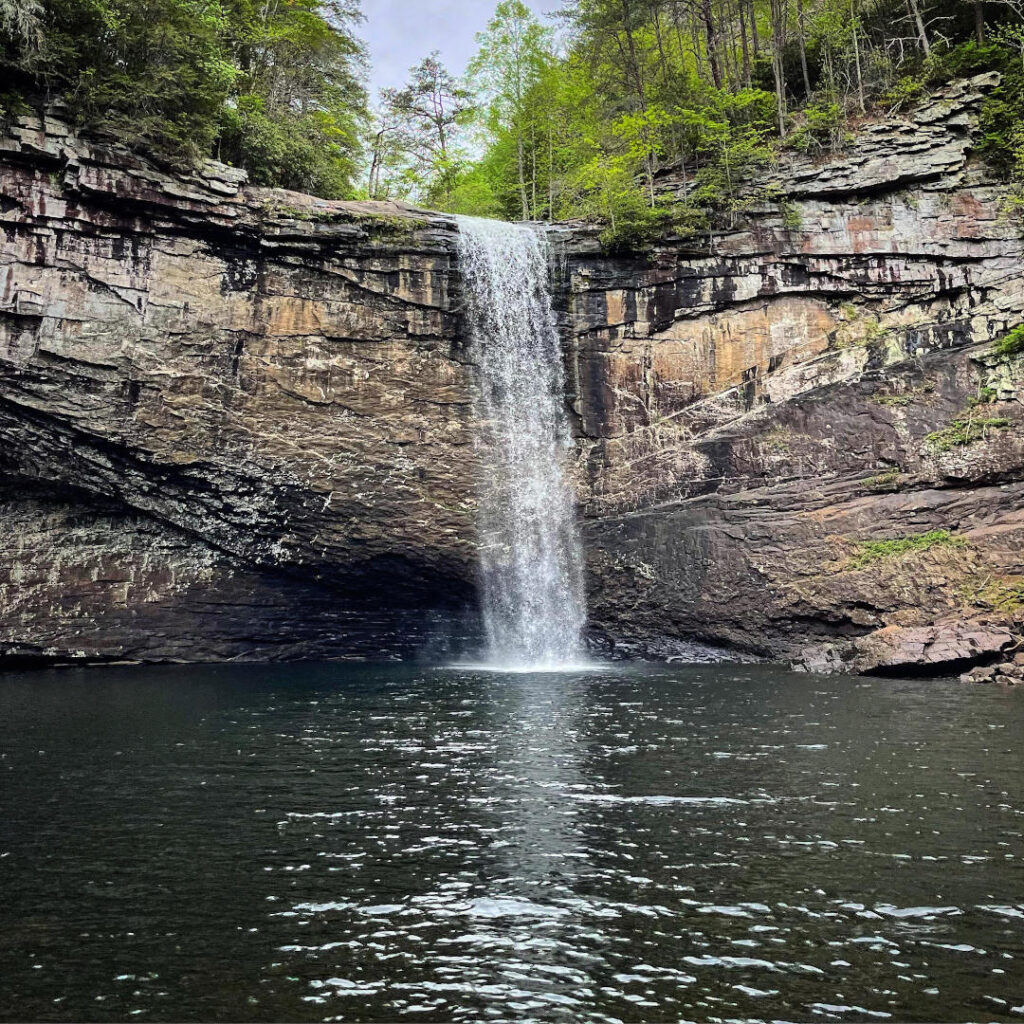
Foster Falls is one of the most popular sport climbing destinations in the southeastern United States, drawing climbers from across the country to test themselves on established routes in the sandstone bluffs surrounding the falls. The routes range from beginner-friendly grades up to serious 5.13 and 5.14 climbs for experienced leads. On a busy weekend it is entirely normal to look up from the plunge pool and see multiple climbers working the walls around you, which is a pretty remarkable backdrop for a waterfall visit. All climbing requires advance online registration through Tennessee State Parks.
Foster Falls is also the southern terminus of the Fiery Gizzard Trail, a 12-mile backcountry route widely considered one of the best day or overnight hikes in Tennessee. If you have an extra day to spare, that trail earns every bit of its reputation. Swimming is permitted in the plunge pool and it makes for a fine way to close out the afternoon before making your way toward Greeter Falls.
3. Greeter Falls: Savage Gulf State Park
Greeter Falls gives you two waterfalls for the effort of hiking to one, and the swimming hole at the base of the lower falls is one of the better natural pools on the entire Cumberland Plateau. It is also completely free, which on a road trip through state parks adds up.
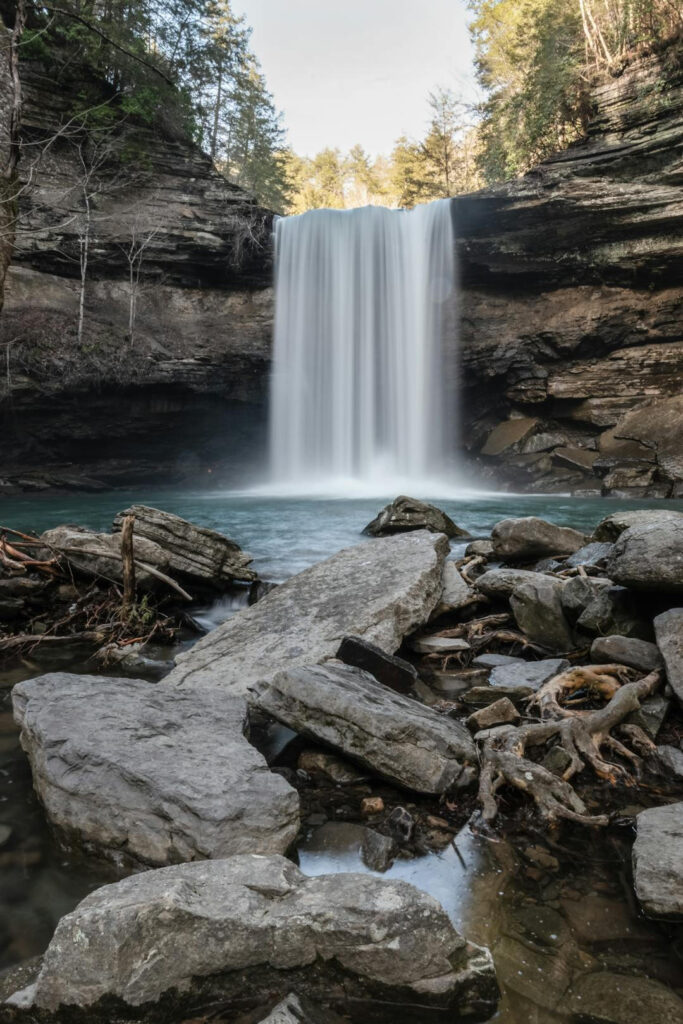
The falls sit just outside Altamont in Grundy County, about 45 minutes northwest of Chattanooga. The loop trail runs just over a mile and visits both falls in sequence: the 15-foot Upper Greeter Falls first, then the 50-foot Lower Greeter Falls, which you reach by descending a spiral staircase cut into the gorge wall. The staircase alone is worth the trip from a photography standpoint.
At the bottom, the lower falls drop into a cold, clear plunge pool that is genuinely inviting on a warm day. One practical note: the pool directly below the upper falls looks swimmable but the park advises against it due to strong currents and the drop downstream. Stick to the lower falls pool and you’ll have no complaints.
The trail also connects to the broader Savage Gulf trail network if you want to extend the day. Boardtree Falls is on the same loop, and the park’s over 50 miles of backcountry trails make it a destination in its own right for serious hikers. A few practical notes: there are no restrooms at the trailhead, jumping from the falls is prohibited, and the falls run heaviest in winter and spring when water levels are highest. Summer visits are still excellent but manage expectations on flow after a dry stretch.
4. Fall Creek Falls: Fall Creek Falls State Park
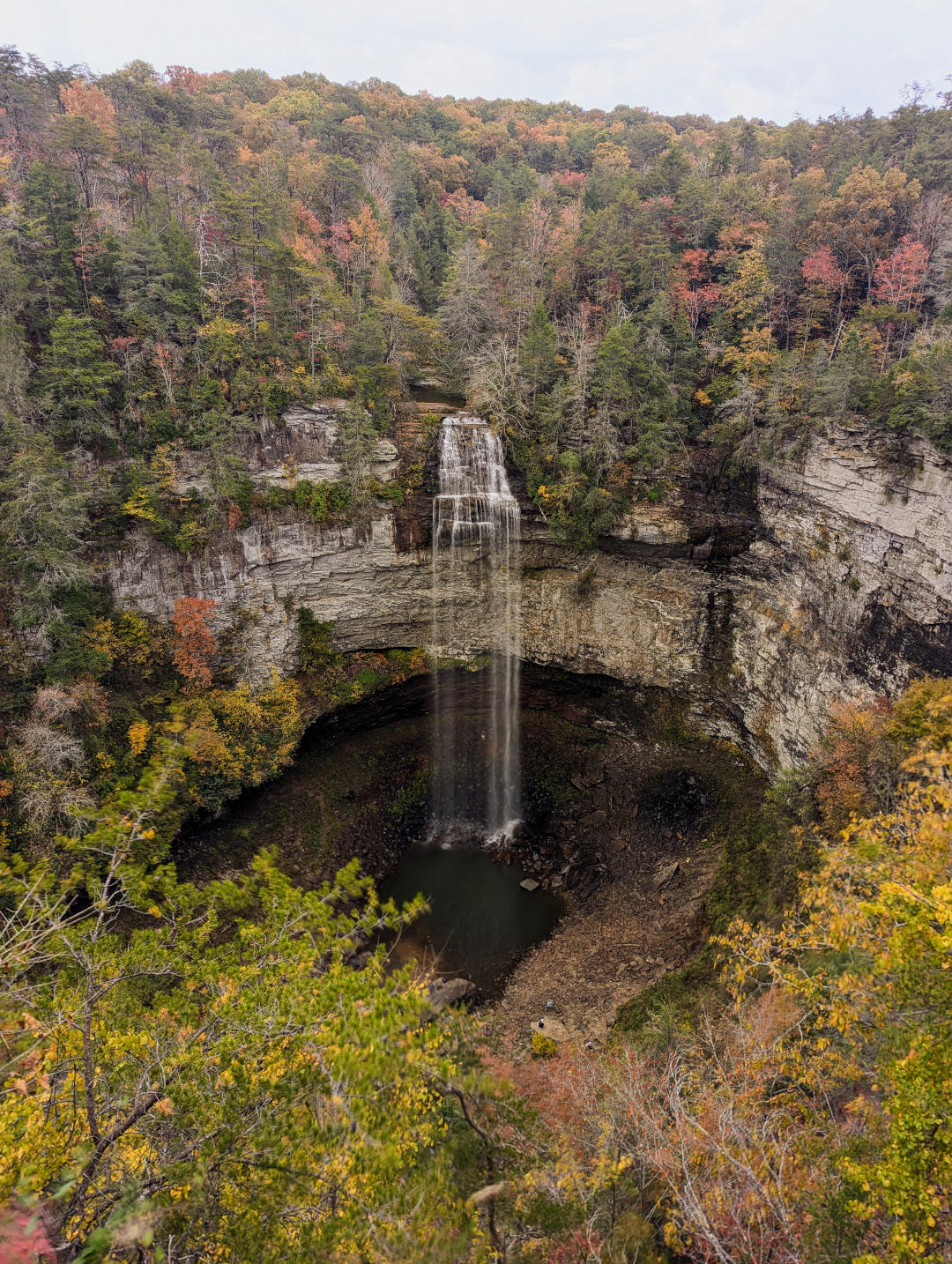
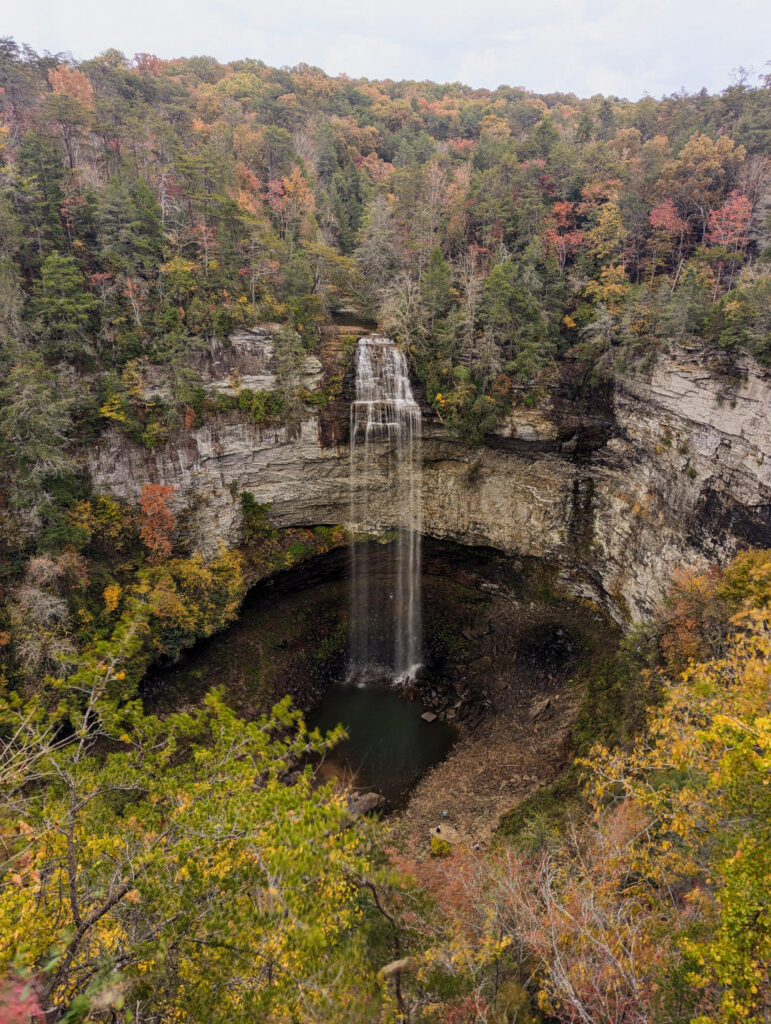
At 256 feet, Fall Creek Falls is one of the highest waterfalls in the eastern United States, and the view from the overlook platform is one of those moments that stops you mid-step. You look out over Cane Creek Gorge and the falls are just hanging there, dropping the full height of a 25-story building into the gorge below. I’ll be honest: I stood at that overlook for a while.
The park itself covers nearly 30,000 acres of the Cumberland Plateau and was originally developed by the Civilian Conservation Corps in the 1930s. It shows in the craftsmanship still visible throughout the grounds. Fall Creek Falls is the headliner, but the park also contains Piney Creek Falls, Cane Creek Falls, Cane Creek Cascades, and Rockhouse Falls, plus over 56 miles of trails running through old-growth forest that received official Old-Growth Forest Network designation in 2020. There is also a lodge with a restaurant, cabins, a lake, camping, and a golf course. This is not just a waterfall stop. It is a full destination.
I stuck to the overlook on my visit and came away thinking the park deserved a lot more of my time than I gave it. The overlook is a short, easy walk from the Scenic Loop Road parking area and is genuinely spectacular on its own terms.
For those who want the full picture, the Base of Falls Trail descends 0.35 miles and roughly 300 feet into the gorge to put you right at the base of the falls. The park rates it as very strenuous, and the climb back out will confirm that. Either way, plan for more than a quick stop. Fall Creek Falls State Park is one of the best state parks in Tennessee and you will regret rushing it.
5. Rock Island State Park: Great Falls of the Caney Fork
Rock Island State Park sits at the confluence of the Caney Fork, Collins, and Rocky Rivers in White and Warren counties, and it gives you two very different waterfalls within the same 883-acre park. Great Falls is a 30-foot horseshoe-shaped cascade below the ruins of a 19th-century cotton textile mill. Twin Falls is something else entirely: two parallel cascades that emerge directly from a cave in the bluff face and spill into the river below. You won’t see that combination at many other places.
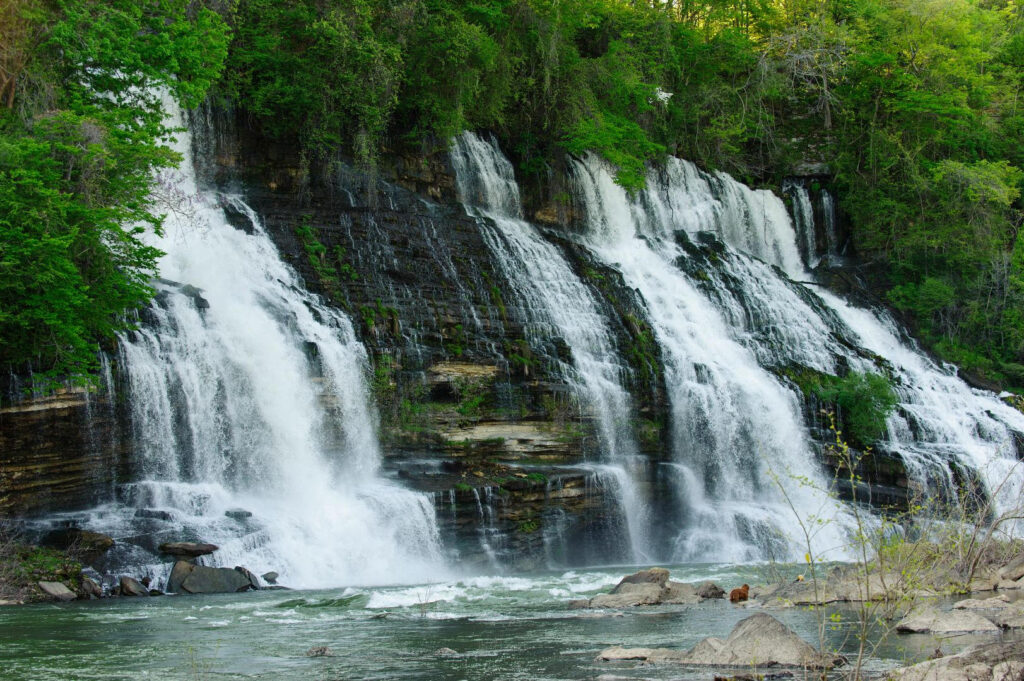
The industrial history here is genuinely interesting. Entrepreneur after entrepreneur tried to harness the power of the Caney Fork through the late 1800s, building mills that the river eventually destroyed in floods. The Falls City Cotton Mill, built in the 1890s, powered a small worker’s town on the bluffs before the river flooded again in 1902 and wiped it out. The stone ruins of that mill are still visible along the Upstream Trail, which puts you right in the middle of that history as you hike. The gorge below the Great Falls Dam is where most of the action happens today, with swimming holes, rock hopping, and nine trails ranging from easy overlooks to strenuous gorge descents.
One important note before you visit: the gorge is managed in coordination with the TVA, which controls water releases from the Great Falls Dam. Access can close without notice depending on water release predictions, and swimming downstream of the powerhouse is never permitted regardless of conditions. Check the park’s website at tnstateparks.com and TVA’s water release data before heading into the gorge. With that caveat understood, Rock Island is one of the more versatile stops on this road trip. It rewards both a quick overlook visit and a longer half-day if you want to explore the gorge, swimming holes, and mill ruins properly.
6. Burgess Falls: Burgess Falls State Natural Area
Most people show up at Burgess Falls expecting one waterfall and leave having seen four, and that’s the thing about this park that keeps it near the top of every Tennessee waterfall conversation: the Falling Water River earns its name on the way to the main event.
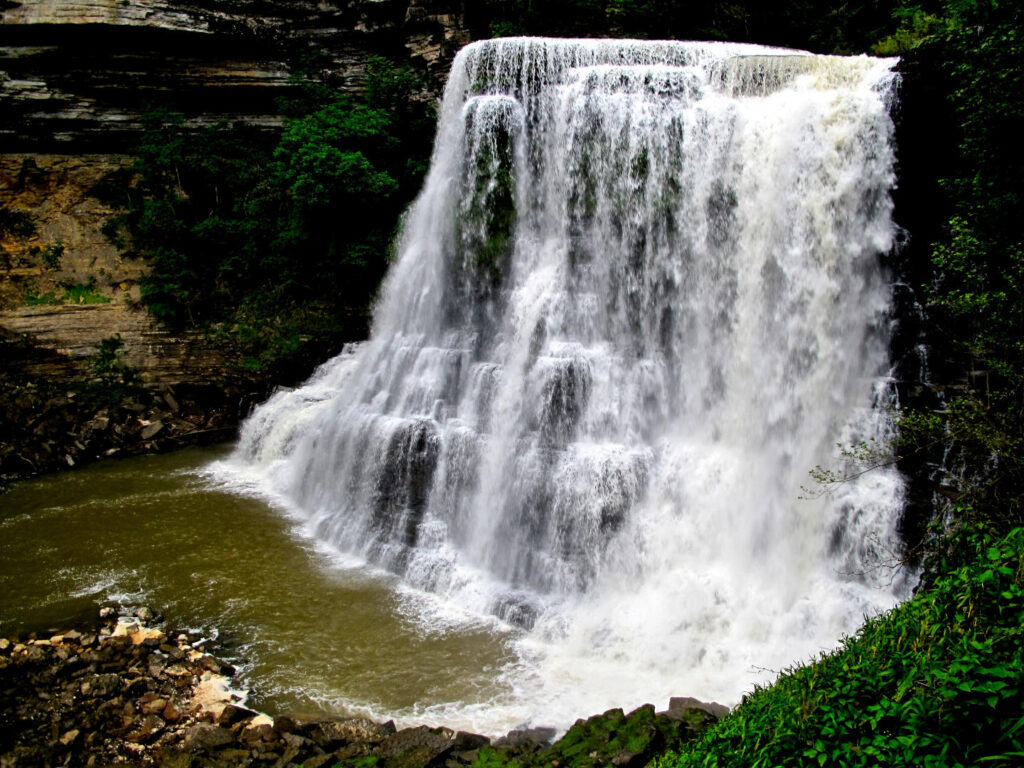
The park sits in Putnam County on the Highland Rim, where the Falling Water River drops roughly 250 feet in elevation over less than a mile before emptying into Center Hill Lake. The River Trail, about 1.3 miles out and back, follows the south bank of the gorge past each waterfall in sequence: the 20-foot Falling Water Cascades, the 30-foot Little Falls, the 80-foot Middle Falls, and finally Burgess Falls itself, which plunges 136 feet into a limestone gorge with sheer walls rising on both sides.
The Burgess family ran a grist mill and sawmill on this river in the 1800s, and a later generation put the river to work again when a hydroelectric plant here powered the city of Cookeville from 1928 to 1944. Remnants of that operation are still visible along the trail.
What most visitors don’t know is that hiking isn’t the only way to experience Burgess Falls. Several local outfitters run guided kayak tours out of Cane Hollow Recreation Area on Center Hill Lake, a roughly 4-mile round trip paddle that brings you to the base of the main falls from below. It’s a perspective the trail simply cannot give you, and by most accounts it’s spectacular. Cumberland Kayak and Adventure Company and Kayaking Adventures of Tennessee are both well-regarded options if you want to go that route (it’s on my list). Note that water levels affect how close you can paddle to the falls, with late spring and early summer offering the best conditions.
For most visitors on a waterfall road trip, the hiking trail is the practical call. It’s free, requires no advance booking, and the four-fall sequence is one of the better short hikes on the plateau. But if you have an extra half day and any interest in paddling, Burgess Falls is one of the more unique kayaking experiences in Middle Tennessee and worth building the trip around. One practical note: the upper parking lot is currently closed due to visitor center construction. Check tnstateparks.com for current access details before you go.
7. Cummins Falls: Cummins Falls State Park
Cummins Falls is the eighth largest waterfall in Tennessee by volume, dropping 75 feet in two tiers into one of the most impressive plunge pools on the Cumberland Plateau. It opened as a state park in 2012 after more than a century as a local swimming hole, and the short overlook trail to the top of the gorge is one of the more accessible great waterfall views in the state.
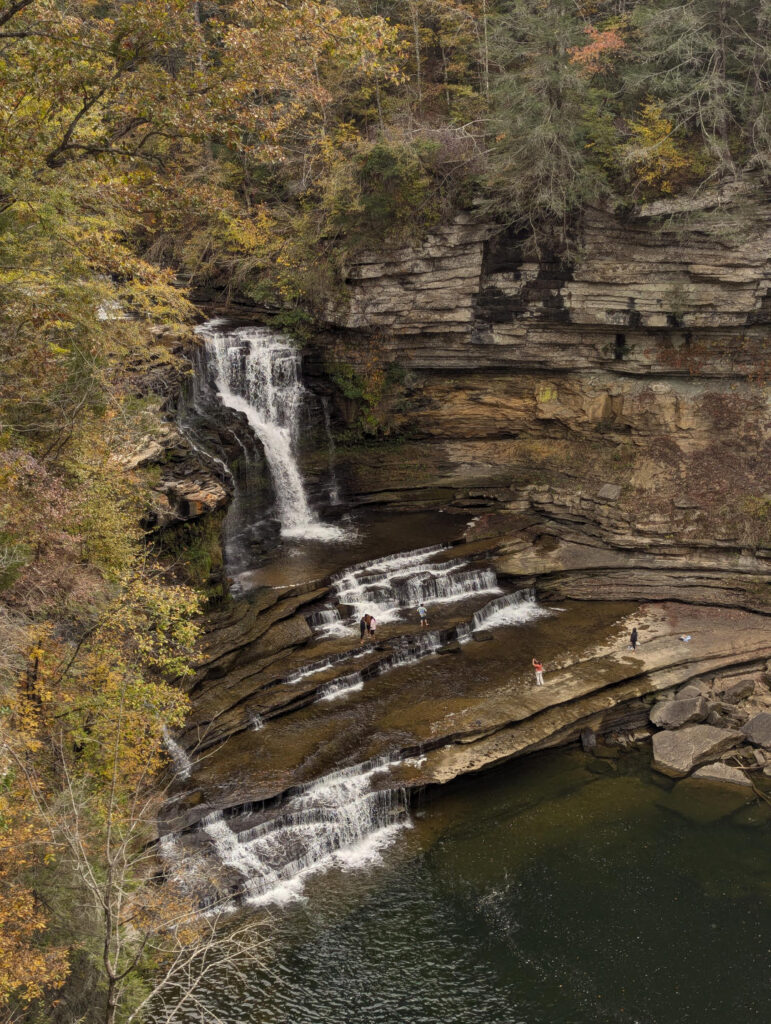
The Falls Overlook Trail runs about 0.4 miles from the visitor center through a shaded forest to a cliffside perch above the falls. From there you get a full frontal view of both drops and the pool below. It is an easy walk for most visitors, and the overlook itself is ADA accessible. We visited on a Sunday in October and only crossed paths with two or three other groups the whole time, which surprised me given how good the payoff is. Your mileage may vary in summer, but it never felt like a crowded destination.
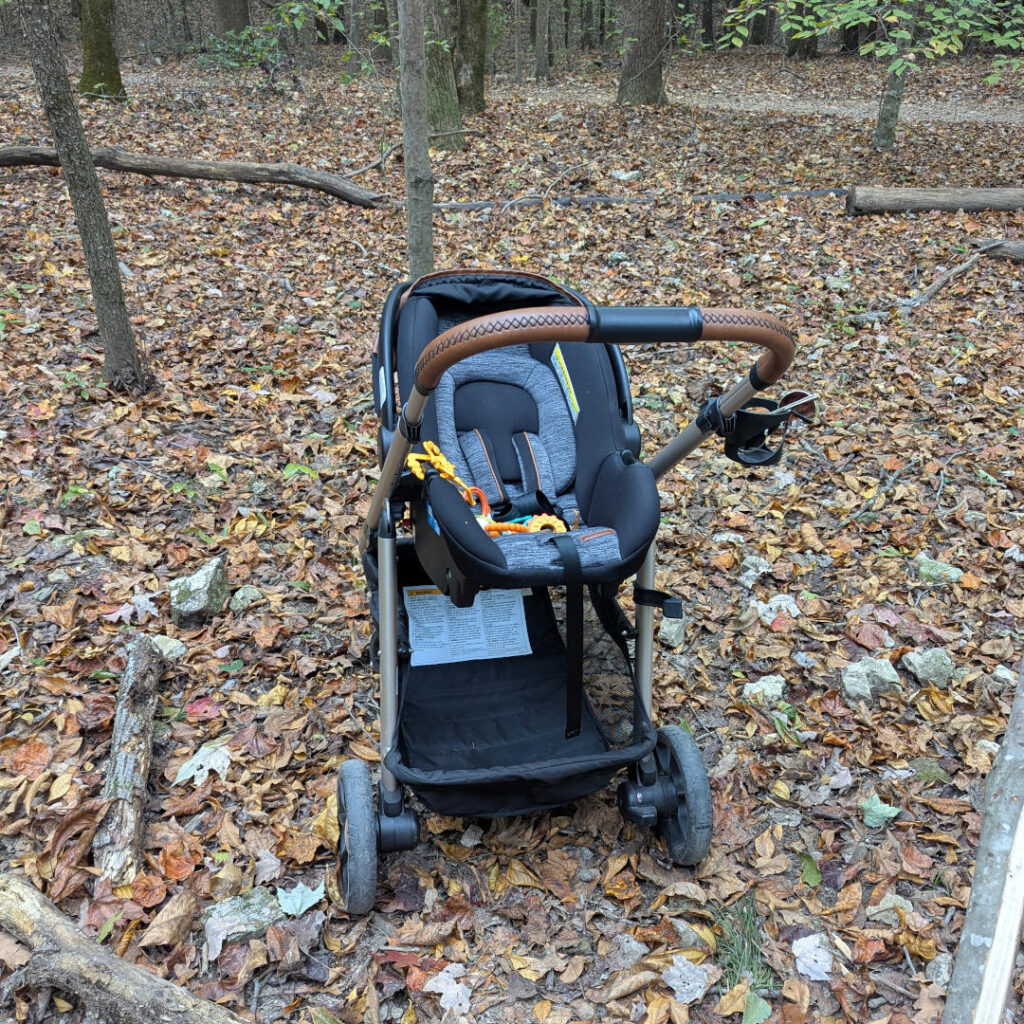
I’ll be the first to admit we did not cover ourselves in glory on the way down. A family heading back to the parking lot cheerfully told us they had taken their stroller all the way to the overlook without any trouble. We loaded the baby in, headed out, and discovered fairly quickly that their definition of stroller-friendly and ours were pretty different. The stroller ended up parked against a tree in the woods while we carried the kid the rest of the way. It was completely worth it. The stroller was still there when we came back.
For those who want more than the overlook, there is a separate hike down into the gorge to the base of the falls that requires a Gorge Access Permit, available through the state park website. It is a rugged, unimproved trail with water crossings and significant elevation drop, and the park takes safety seriously given the flash flood risk in the gorge. Check conditions before you go and book your permit in advance on weekends. The overlook is the right call for most visitors, and it is genuinely excellent on its own terms.
8. Ozone Falls: Cumberland County
Ozone Falls is a 110-foot freefall waterfall sitting just off US Highway 70 in Cumberland County, and the gap between the effort required to reach it and the payoff waiting at the bottom is one of the more pleasant surprises on this entire list.
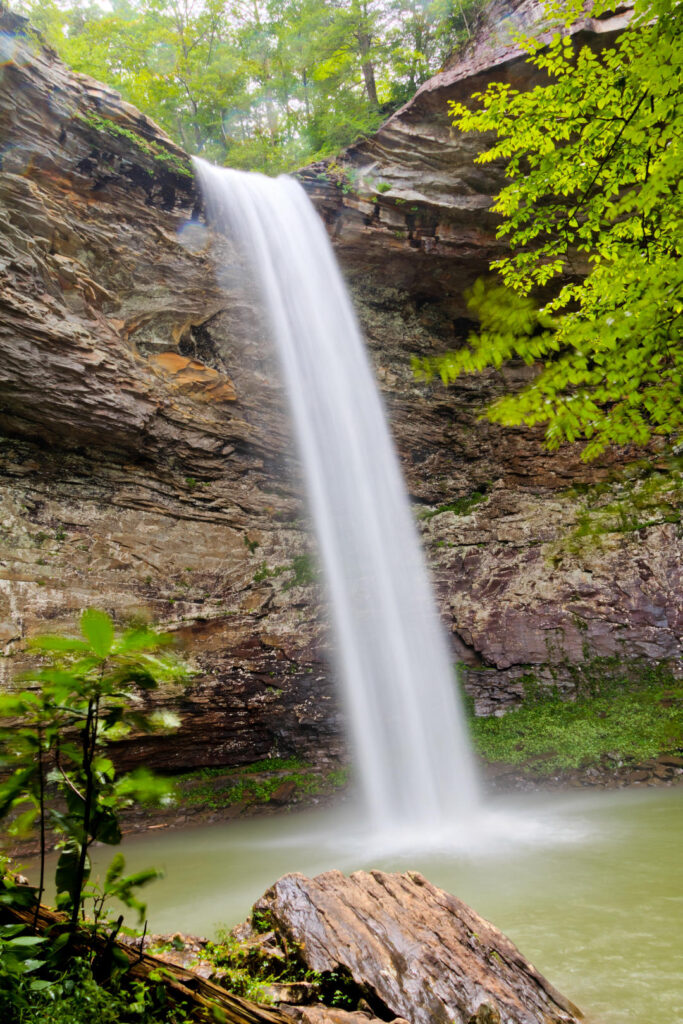
The falls have been a landmark on this stretch of road for a long time. Migrants traveling the old Walton Road across the Cumberland Plateau wrote about them in journals as far back as the early 1800s, when the road connected East and Middle Tennessee. In the 1860s a local miller named McNair ran a grist mill above the falls, which is how they got their first name.
The community that grew up nearby went through a few names before settling on Ozone in 1896, reportedly because the mist from the falls was thought to give the local air a particularly invigorating quality. Disney apparently agreed: Ozone Falls was selected as a filming location for the 1994 live-action Jungle Book. The rock house amphitheater carved into the gorge wall behind the falls by centuries of erosion gives the whole scene a quality that is hard to describe until you’re standing in front of it.
The trail from the US 70 parking area is less than a third of a mile one way, dropping steeply into the gorge to the plunge pool below. It is rocky and can be slippery, so sturdy footwear is worth it even for a short hike. The falls themselves run best in spring after rain; summer visits are still worthwhile but water flow can be modest in a dry stretch.
Ozone Falls is a natural stop on the drive east toward the Smokies, and the kind of place that makes you feel like you found something most people blow past at 70 miles an hour on the interstate. You will not regret pulling off.
9. Stinging Fork Falls: Stinging Fork Falls State Natural Area, Spring City
Stinging Fork Falls is the kind of place that doesn’t look like anything special from the road, which is precisely why most people drive right past it. That suits the people who stop just fine.
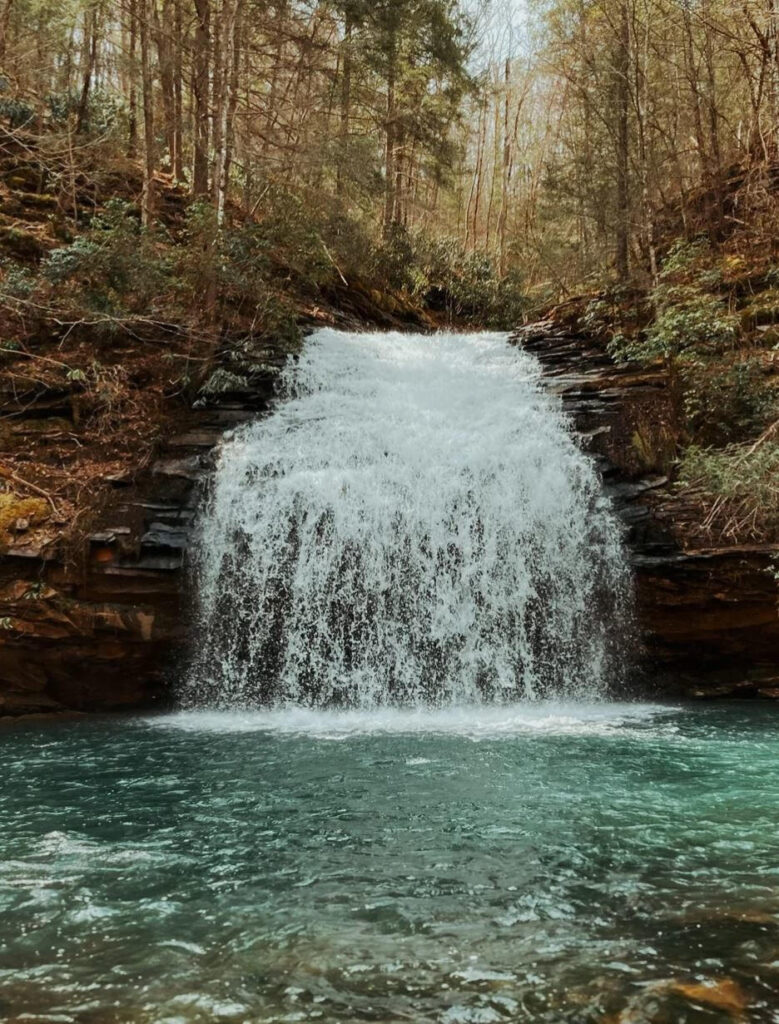
The falls sit inside a 783-acre state natural area in Rhea County near Spring City, accessed off Shut In Gap Road from Highway 68. The 30-foot waterfall drops in a distinctive fan shape over the rock face before spilling into one of the cleaner, quieter swimming holes in East Tennessee: a blue-green pool at the base of the gorge that genuinely earns every superlative thrown at it. The area is part of the Cumberland Trail State Park system, and the trailhead parking lot fits about 20 vehicles. No camping, no cell service once you’re in the gorge, open sunrise to sunset.
The trail runs about 1.9 miles roundtrip and does a good job of disguising itself. The first half mile from the parking area is flat and easy, following the creek through shaded forest with some smaller cascades along the way. Then the trail splits and heads down into the gorge, and the character of the hike changes considerably: steep, rocky, with some genuine scrambling in places before you reach the falls. It is absolutely worth it, but go in knowing the easy opening act is not the whole story. Sturdy footwear is a real requirement here, not a suggestion.
Download your maps before you leave the highway (seriously, there is no cell service at the natural area and no Google Maps rescue if you miss the turn), and keep an eye out for the trailhead sign on Shut In Gap Road. Like most Tennessee waterfalls, Stinging Fork flows best in winter and spring; summer visits are still worthwhile but water volume can drop significantly in a dry stretch.
10. Grotto Falls: Great Smoky Mountains National Park
Grotto Falls is the only waterfall in Great Smoky Mountains National Park where the trail actually passes behind the water, and that one fact changes the entire character of the visit. You are not just looking at the falls from the outside. You walk through them.

The falls drop 25 feet into a cool mountain cove, and the Trillium Gap Trail reaches them at 1.3 miles from the trailhead before continuing on all the way to the summit of Mt. LeConte. The round trip to the falls is 2.6 miles with about 500 feet of elevation gain, rated moderate. The trail passes through stretches of old-growth forest and rhododendron and crosses several small streams without footbridges, though none are difficult.
In spring the wildflowers along the trail are worth the hike on their own. It’s one of the reasons, Great Smoky Mountains National Park is a top ten Spring National Park. The same trail is used by the pack llamas that carry supplies up to LeConte Lodge, so there is a real chance you will find yourself stepping aside for a mule train somewhere between the trailhead and the falls. That is not something you experience on many waterfall hikes.
A few practical notes worth knowing before you go. The parking lot at the Trillium Gap Trailhead holds 18 vehicles, which is not a lot for one of the more popular trails in the most visited national park in the country. The NPS recommends having a backup plan if the lot is full, and arrival before 8am is strongly advised on weekends and during peak season. A paid parking tag is required for stays longer than 15 minutes. No dogs are allowed on this trail.
The Roaring Fork Motor Nature Trail that provides access to the trailhead closes December through March, so plan your visit for the spring through fall window. Access is off Roaring Fork Motor Nature Trail at stop number 5, reached via Cherokee Orchard Road from Gatlinburg traffic light number 8.
11. Laurel Falls: Great Smoky Mountains National Park
Important: Laurel Falls Trail is currently closed. The NPS closed it on January 6, 2025 for an 18-month rehabilitation project, with an expected reopening around mid-2026. Confirm current status at nps.gov/grsm before planning your visit. This is the one entry on this list most likely to have changed since publication.
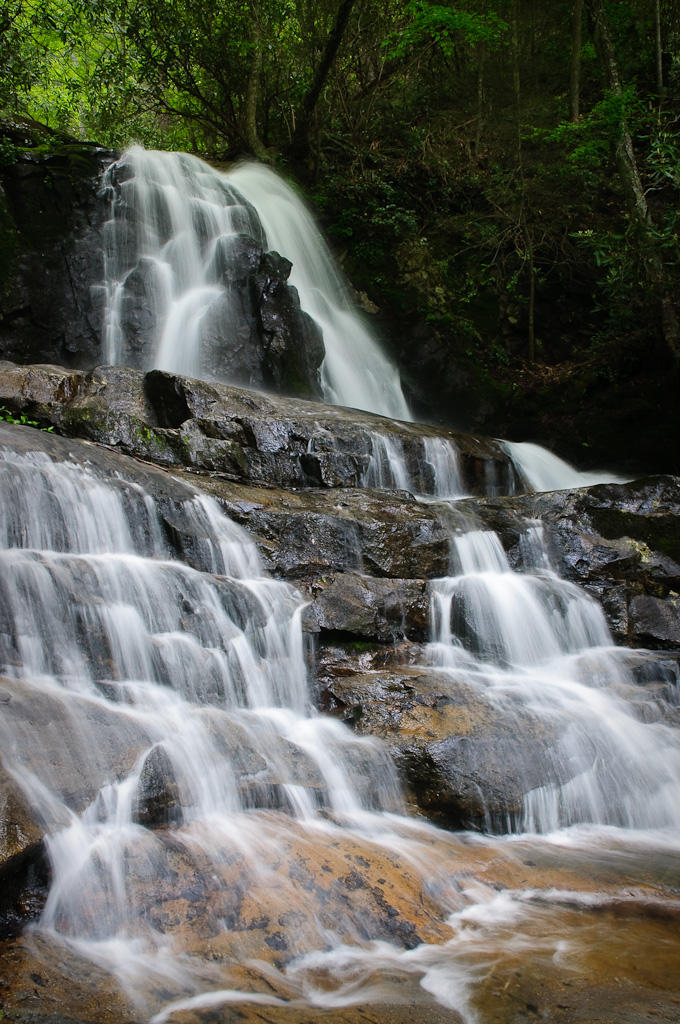
With that said, here is what you are looking forward to when it reopens. Laurel Falls drops about 80 feet in two tiers separated by a footbridge that puts you directly between the upper and lower cascade, and it has historically been the most visited waterfall trail in the entire national park. More than 300,000 people hike it every year. The paved trail runs 2.6 miles roundtrip, making it one of the more accessible waterfall hikes in the Smokies for visitors of all fitness levels.
The rehabilitation is genuinely worth waiting for. The existing trail surface dated back to 1963 and was overdue for replacement. When it reopens, visitors can expect a repaved and widened trail, new viewing platforms at the falls, roughly 50 additional parking spaces, and a proper pedestrian pathway connecting the parking area to the trailhead. If you are visiting the Smokies while the trail is still closed, Grotto Falls is the NPS’s own recommended alternative and, between the two, is the more memorable experience anyway.
12. Abrams Falls: Great Smoky Mountains National Park, Cades Cove
Abrams Falls may not be the tallest waterfall in the Smokies, but it is almost certainly the most powerful. Abrams Creek drains an unusually large watershed for a Smokies stream, which means the falls run strong even when conditions elsewhere are dry. Standing at the base when the creek is running full is a genuinely loud, wet, visceral experience in a way that most waterfall visits are not.
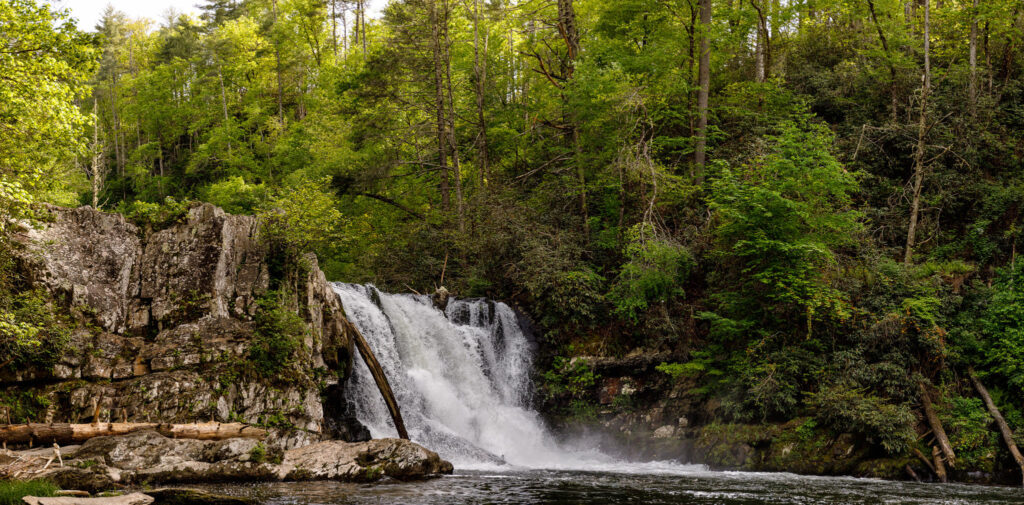
The falls are reached via a 5-mile roundtrip trail from the Cades Cove loop road, which adds a full layer of context to the visit. Cades Cove itself is one of the most scenic drives in the national park, passing preserved 19th-century homesteads, churches, and a working grist mill through a wide mountain valley that European-American settlers began farming in the early 1800s. The trail from the trailhead follows Abrams Creek through the gorge with about 550 feet of elevation change, involving some rock hopping near the falls. Not brutal, but not a casual stroll either.
A couple of practical notes before you go. Swimming in the plunge pool is not recommended by the NPS due to strong currents, though people do wade in the shallower edges near the bank. More importantly, plan extra time for the Cades Cove loop road itself. It is one-way, it backs up significantly on weekends and during fall foliage season, and there is no shortcut. If you can do this on a weekday morning you will have a much better time. Save Abrams Falls for the last stop on your Smokies swing. The cove setting and the hike make for a strong finish to the whole road trip.
13. Bald River Falls: Cherokee National Forest, Tellico Plains
Bald River Falls is the kind of waterfall that rewards people willing to take the scenic route, and the Cherohala Skyway is one of the better scenic routes in the Southeast. The falls sit in the Tellico Ranger District of the Cherokee National Forest, where the Bald River drops 90 feet into the Tellico River at a spot you can see from the road bridge without ever getting out of your car. Most people get out of their car.
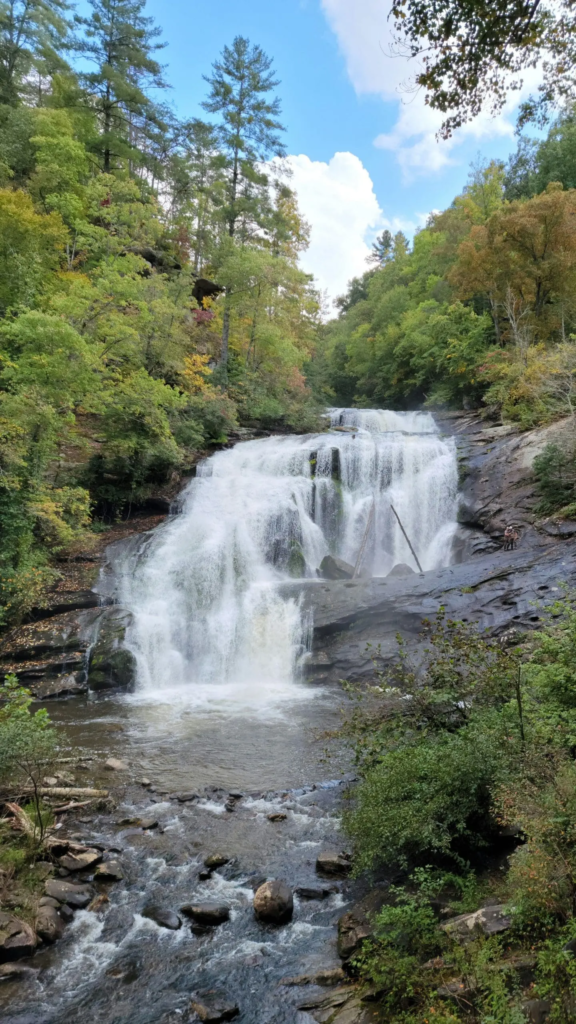
The road that brought you here, FR 210 along the Tellico River, follows the bed of a logging railroad built by the Babcock Lumber Company in the early 20th century. The company nearly completely logged the Bald River basin before the area was protected as national forest. What you are driving through now is old-growth recovery, and it is striking. Arrive after rain and the river is running full alongside the road the entire way in, building anticipation for the falls themselves.
From a photography standpoint, this is one of the more interesting stops on the list. The road bridge puts you at roughly eye level with the falls as they hit the Tellico, which is a great natural framing. On high water days the spray reaches the bridge itself, so a weather-sealed camera or a lens cloth is worth having ready.
For those who want to get closer, there is a rocky path down to the base of the falls, and a short trail from the parking area leads up to a view from the top. The 5.6-mile Bald River Trail also begins here for anyone wanting a longer hike into the gorge. To get there, turn off the Cherohala Skyway at Tellico Plains onto FR 210 and follow it about 6 miles upstream. Parking is limited, so weekdays are strongly recommended.
How to Road Trip the 13 Best Waterfalls in Tennessee
These 13 falls aren’t just a collection of stops. They form a genuine five-day loop starting and ending in Chattanooga, and the route flows well enough that you can follow it straight through or break it into regional chunks depending on how much time you have. Here is how we’d run it.
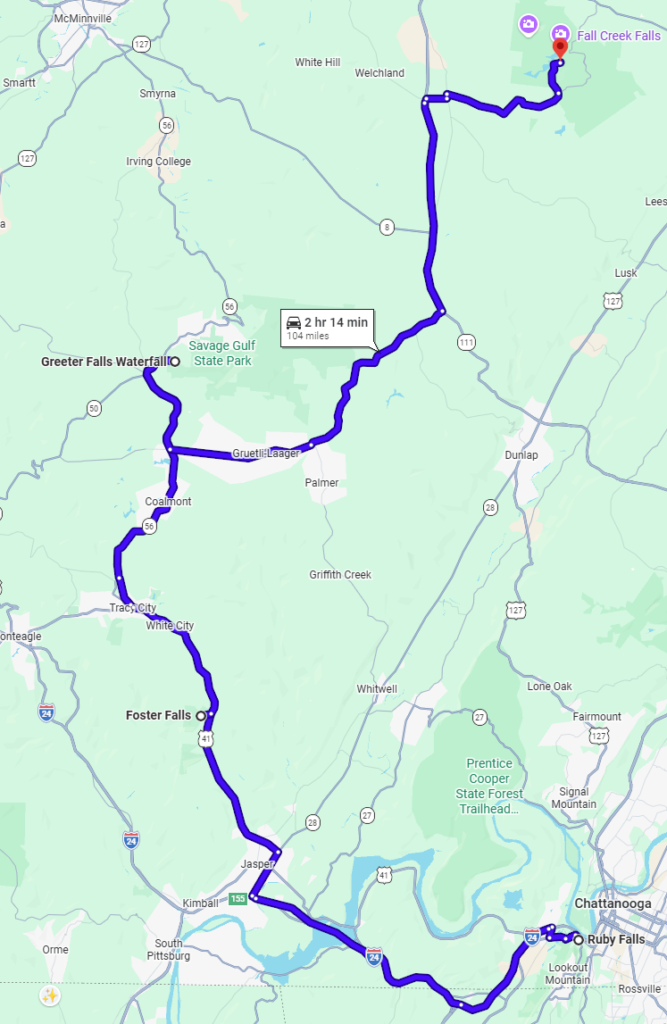
Day 1: Chattanooga to Fall Creek Falls State Park
The first tour at Ruby Falls runs at 8am Eastern. Book it. Getting that first slot of the day puts you back outside by 10am and sets the whole day up right. From Ruby Falls you’re heading west toward Foster Falls, and here is a detail worth keeping in mind: the moment you cross into Marion County you pick up an extra hour moving into Central Time.
That hour works in your favor all day and turns what looks like a tight itinerary into a genuinely comfortable one. Foster Falls, Greeter Falls, and an overnight at Fall Creek Falls State Park are all well within reach. Book a cabin or lodge room inside the park if you can. It’s worth it to wake up already there.
Day 2: Fall Creek Falls State Park to Cookeville
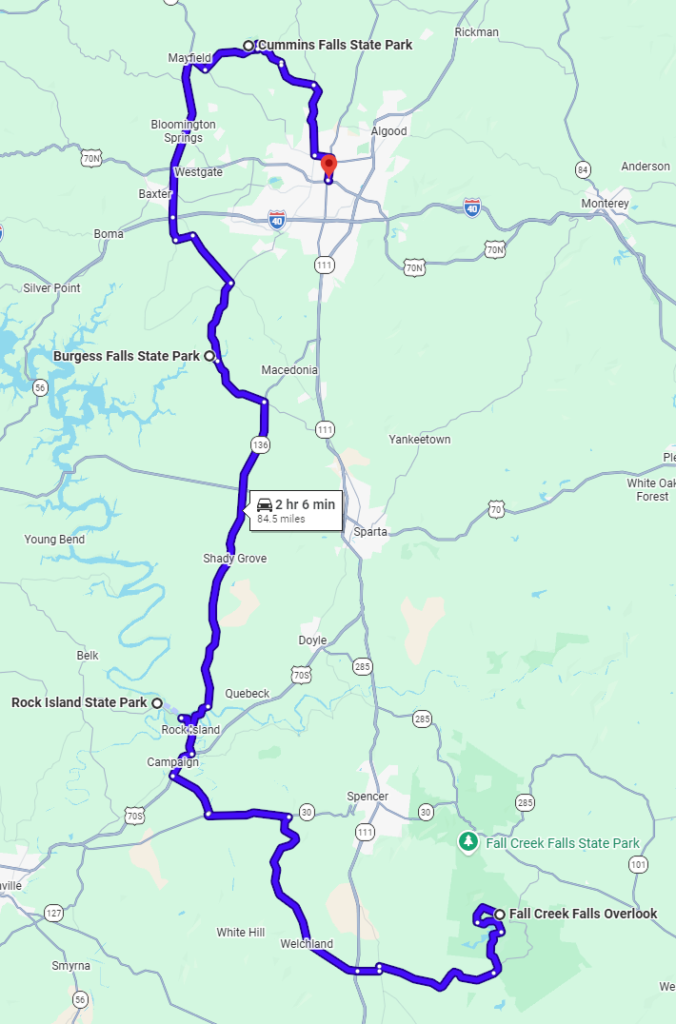
Give Fall Creek Falls the morning it deserves before heading north. Rock Island, Burgess Falls, and Cummins Falls all sit along a logical northward run toward Cookeville, and each one is worth the stop in its own right. This day has more waterfalls than any other on the trip, but the pacing works in your favor because none of them are far from each other and the driving is easy plateau country the whole way. Cookeville is a solid overnight base with plenty of good food options to recover from what should be a satisfying full day on the water.
Day 3: Cookeville to Townsend
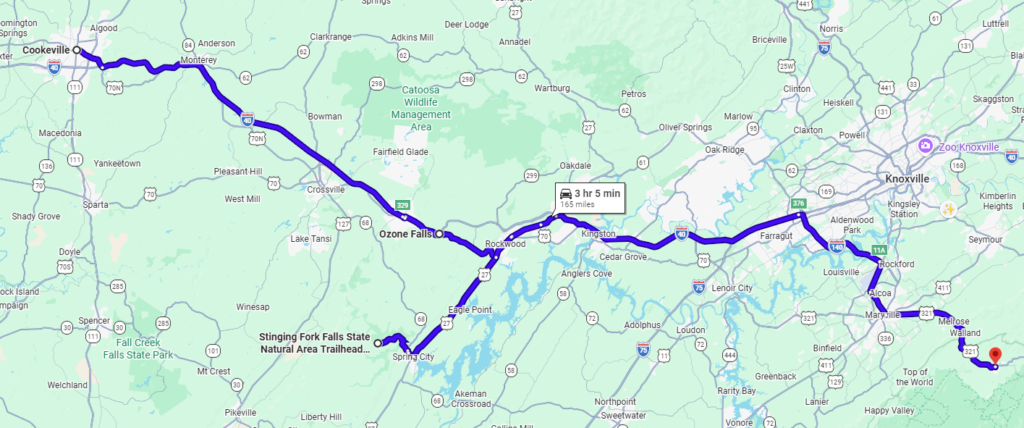
This is the longest driving day on the trip, which is exactly why Ozone Falls and Stinging Fork Falls both earn their place on the itinerary. Ozone Falls sits right off I-40 heading east out of Cookeville: barely a detour at all. From there you’ll head south toward Spring City for Stinging Fork Falls, which deserves more of your time than the short trail distance suggests.
Download your maps before you leave the highway (seriously, there is no cell service at the natural area and no Google Maps rescue if you miss the turn), and keep an eye out for the trailhead sign on Shut In Gap Road. Neither hike is long, but both reward taking your time rather than rushing through to make miles.
The drive from Stinging Fork east to Townsend winds through pleasant valley country on Highway 68, and Townsend is hands down the right call over Gatlinburg for this trip. We’ve stayed there and the difference is night and day. It’s quieter, less expensive, and far less crowded, and it puts you at exactly the right doorstep for the next two days. There is a reason why it’s one of my favorite places in Tennessee. The Cades Cove entrance is a few minutes down the road and the Foothills Parkway junction for day five is right in town.
Day 4: The Smokies
Two nights in Townsend gives you the flexibility to run the Smokies at your own pace, which is the right approach. Grotto Falls is the one where parking genuinely requires an early arrival: the lot is small and fills faster than most people expect, especially in summer and fall. Give Abrams Falls and the Cades Cove loop road more time than you think you’ll need, particularly on weekends when the one-way loop backs up with no way around it.
Laurel Falls Trail is currently closed for rehabilitation through approximately mid-2026. Check nps.gov/grsm for current status before your trip. When it reopens it slots naturally into a Smokies day and will be worth adding. Also note that Roaring Fork Motor Nature Trail, which is the access road for Grotto Falls, closes December through March, so spring through fall is the right window for the full Smokies leg.
Day 5: Townsend to Chattanooga via the Dragon and the Cherohala Skyway
Fill your gas tank in Townsend before you leave. There are no services on the Tail of the Dragon, no gas stations on the Cherohala Skyway, and nothing useful in between for several hours of driving. Pack food and water for the day.
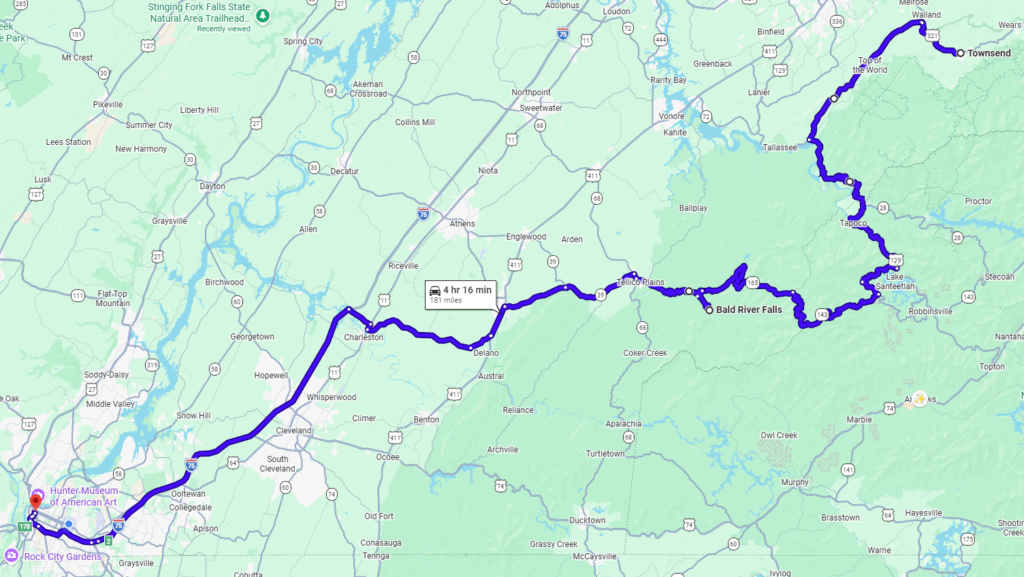
From Townsend the Foothills Parkway connects directly to US-129 and the Tail of the Dragon heading toward Deals Gap. The Foothills Parkway is a genuinely underrated drive in its own right (worth slowing down for if you have the time), but day five has a lot of great road ahead of it so use your judgment on stops.
The Dragon is 11 miles of 318 curves at a 30mph speed limit, and it earns every word of its reputation. This is not a scenic overlook road: it demands your full attention the whole way through. Use the pulloffs, let faster traffic pass, and enjoy the fact that the entire stretch borders the national park with no driveways, no intersections, and nothing to interrupt the experience.
At Deals Gap you cross into North Carolina and pick up the Cherohala Skyway heading west. I’ve driven the Skyway and the overlooks alone are worth the trip. The Skyway is 43 miles of high-elevation mountain road that climbs to over 5,400 feet before descending back into Tennessee through the Cherokee National Forest.
It’s a completely different character from the Dragon: wide, sweeping, with 15 overlooks and views that on a clear day stretch further than you’d believe. There are no services for the entire crossing, so take the overlooks and don’t rush it. About six miles before Tellico Plains, turn onto FR 210 for one last waterfall at Bald River Falls. From there, I-75 south brings you back to Chattanooga to close the loop.
It’s a strong way to finish a Tennessee waterfall road trip. You started underground in a cave on Lookout Mountain and you’re ending on one of the great scenic drives in the Southeast with a 90-foot roadside waterfall as your last stop. Tennessee doesn’t run out of ways to make the drive worth it.
Wrapping Up the Best Waterfalls in Tennessee
Tennessee’s waterfall lineup is more diverse and more accessible than most people expect. This list runs from a guided cave tour 1,120 feet underground in Chattanooga to a roadside pulloff on a Cherokee National Forest logging road to a five-mile gorge hike inside the most visited national park in the country. Thirteen falls, three distinct regions, and something genuinely worth stopping for at every level of experience and ambition.
If you have never hiked a day in your life, start with Ruby Falls, the Cummins Falls overlook, or Ozone Falls. All three deliver an impressive payoff for minimal effort and will give you a real sense of what this state has to offer without requiring anything you are not ready for. If you are a serious hiker looking for more of a challenge than this list provides, Savage Gulf and the Bald River Gorge Wilderness are both right there waiting for you.
All that being said, the waterfalls themselves are only part of what makes this trip worth doing. The drives between them, the plateau country, the Cherohala Skyway, the Tail of the Dragon, Little River Road through the Smokies, are experiences in their own right. Tennessee rewards the people who slow down and pay attention to what is happening between the destinations, not just at them.
Whether you run all 13 on one loop or check them off a cluster at a time, you are going to come home with a longer list of reasons to go back. If you want help putting together your own version of this trip, feel free to reach out at triphelp@floridamanontherun.com. I’m always happy to talk through a Tennessee waterfall road trip itinerary.
If this post has helped you plan your next trip and you’d like to help me continue writing and travelling I’d greatly appreciate your support. Following me on social media will help you stay in touch, or you can get a free custom itinerary by signing up for my newsletter!
Don’t Forget to Pin by Using the Images Below!



Leave a Reply